Do You Actually Know What Baking Tools You Own? (Most of Us Don’t)

March 13, 2026
by marciadex
Blog, , , ,

Let me ask you something kind of embarrassing: how many cookie cutters do you own right now? Not a rough guess — the actual number. Do you know every mold in your collection? Every specialty pan you bought for that one order and then shoved in a bin somewhere?

Yeah. Me neither. Or at least, I didn’t for a long time.

If you’ve been baking for more than a year or two, you’ve probably hit that wall where your tools start multiplying faster than you can keep track of them. A cutter set here, a silicone mold there, a specialty cake pan from that one sale you couldn’t resist. Before you know it, you’re digging through bins trying to find the thing you know you have but cannot locate.

And here’s the part nobody talks about: that disorganization costs you real money.

The Problem Is More Common Than You Think

I was browsing CakeCentral forums (a rabbit hole I do not recommend at 10pm) and found a thread about organizing cookie cutters that had bakers describing their collections in the hundreds — one person mentioned having over 3,000 cutters. Three thousand. And the consensus in that thread? Almost everyone had bought duplicates by accident because they simply didn’t know what they already had.

One baker put it perfectly: she kept a list on her computer and wanted to add photos someday because when she’s talking to a customer, she needs to know exactly what shapes she can offer — fast. Another said she kept her inventory on a Palm Pilot (a Palm Pilot!) so she wouldn’t duplicate when she was out shopping.

These are resourceful people doing their best with whatever tools they have. But the underlying problem hasn’t changed in twenty years: there’s no good dedicated solution for tracking what baking equipment you actually own.

What Happens When You Don’t Track Your Tools

Here’s what the chaos actually looks like in practice — and I’ve lived most of these:

You buy duplicates. You’re at a craft store, you see a snowflake cutter, you think “I might have this but I’m not sure,” and you buy it anyway. Three dollars becomes thirty when it happens ten times a season.

You tell customers you can’t do something — when you actually can. A customer asks if you have a specific shape and you say no because you don’t remember that you bought it eighteen months ago. That’s a missed opportunity and a less-than-confident impression.

You waste time hunting instead of baking. Twenty minutes before you’re supposed to start an order is not the time to discover you can’t find the pan you needed. But that’s exactly when it happens.

You can’t accurately price your work. If you don’t know what equipment you have, you can’t account for the wear and replacement cost of those tools in your pricing. Your molds, cutters, and pans are business assets — they have value and they have a lifespan.

You keep buying storage solutions that don’t solve the root problem. Labeled bins are great. Pegboards are great. But physical organization alone doesn’t tell you what you own when you’re away from your workspace — like when you’re at a baking supply shop, on your phone, trying to remember if you already have a 6-inch hexagon pan.

What Bakers Are Actually Doing (And Why It’s Not Enough)

Scroll through any baking forum or Facebook group and you’ll see the workarounds people have cobbled together:

Spreadsheets are the most common answer. Google Sheets, Excel, whatever they have access to. It works — until it doesn’t. Spreadsheets require you to actually update them every time you buy something new (who has time for that?), they’re not built for photos, and they don’t surface information quickly when you’re mid-conversation with a customer.

Photo inventories on CDs or phones. Yes, people have been taking photos of their cutters and saving them to discs to carry around. It’s clever. It’s also a lot of manual effort for something that should be simple.

Memory and vibes. Honestly? Most people. Which is why duplicate buying is basically a rite of passage in this community.

General inventory apps. There are plenty of apps built for retail inventory or crafting supplies. They’ll do the job in a pinch, but they’re not built with bakers in mind. They don’t know what a silicone cavity mold is. They don’t have fields for “condition,” “size,” or “holiday theme.” You end up making the tool work for you instead of the other way around.

What Actually Needs to Exist

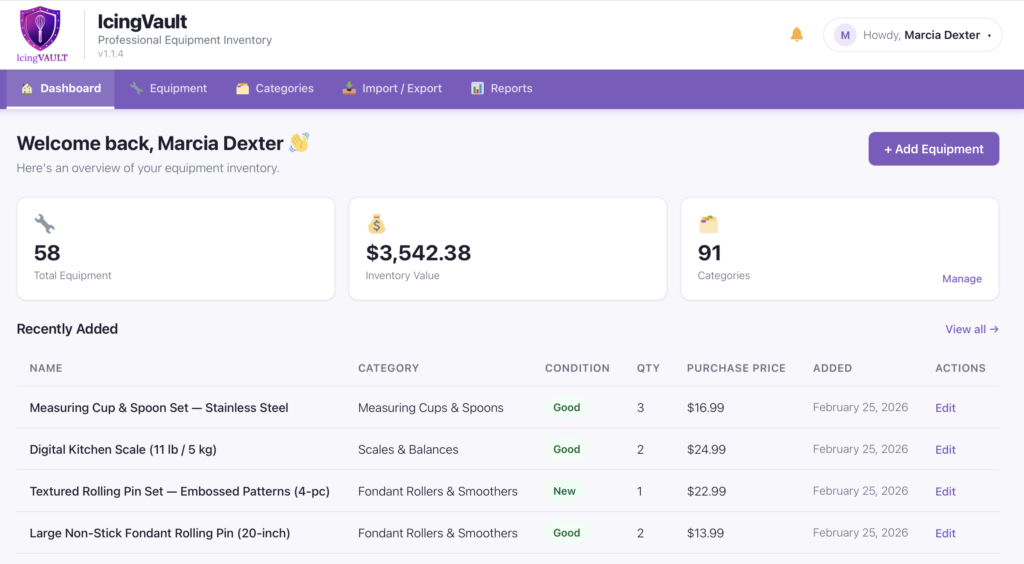
What bakers actually need — and what I kept wishing existed every time I dug through my own bins — is something built specifically for this. A way to catalog equipment by category, add photos right from your phone, note condition and quantity, and pull it up instantly when you’re talking to a customer or standing in an aisle trying not to buy something you already own.

That’s the entire reason I started building IcingVault.

IcingVault is a bakery equipment inventory tracker built for home bakers and cottage food operators. Not a general spreadsheet template you have to wrestle into shape. Not a big expensive software suite built for commercial kitchens. Something that actually makes sense for the way we work — where “inventory” means cookie cutters organized by season, silicone molds by cavity count, and cake pans by size and finish.

I’m still building it. I’ll be honest with you about that, because that’s how I operate here. But it’s being built by someone who has lived this exact frustration, not by a developer who googled “what do bakers need.”

In the Meantime: A Starting Point

If you want to start getting a handle on your equipment right now, here’s the simplest version that actually works:

Pick one category — just one. Cookie cutters, cake pans, silicone molds, whatever is causing you the most grief. Go through that category, take photos on your phone, and drop them into a Google Photos album labeled by theme or type. Add a quick note to each photo with size, material, and where you store it. That’s it. Imperfect and incomplete is still a thousand times better than nothing, and you can build from there.

The goal isn’t a perfect system on day one. It’s knowing what you have well enough to stop buying duplicates and start answering customer questions with confidence.

You Deserve Tools That Actually Work for You

One thing I’ve learned from running a real bakery is that the business side — the tracking, the pricing, the organizing — can quietly drain just as much energy as the baking itself. And when the tools don’t exist or aren’t built for people like us, we end up spending that energy on workarounds instead of on our actual craft.

That’s what SweetTube Academy is here to change. Not by telling you what the experts say. By figuring it out alongside you and building the tools we both need.

If IcingVault sounds like something you’ve been waiting for, head over  sweettubeacademy.com/icingvault. And if you have a tool-tracking system that’s working for you right now — a spreadsheet, a method, anything — drop it in the comments. I genuinely want to know what you’re doing. It helps me build better.

We’re in this together.

— Marcia


[...]

How to Price Homemade Baked Goods: Real Questions From Home Bakers (And What to Do About It)

March 02, 2026
by marciadex
Blog, , , , , ,

If you’ve ever finished a big order, done the math, and felt your stomach drop — you already know the problem. Most home bakers are losing money without realizing it. Not because they’re bad at baking. Because they were never taught how to price homemade baked goods correctly.

Across Reddit threads, CakeCentral forums, and cottage food Facebook groups, the same questions come up every single week. We pulled the most common ones and answered them honestly — including what the math actually looks like and how home baker pricing software like BatterSuite takes the guesswork out of it.

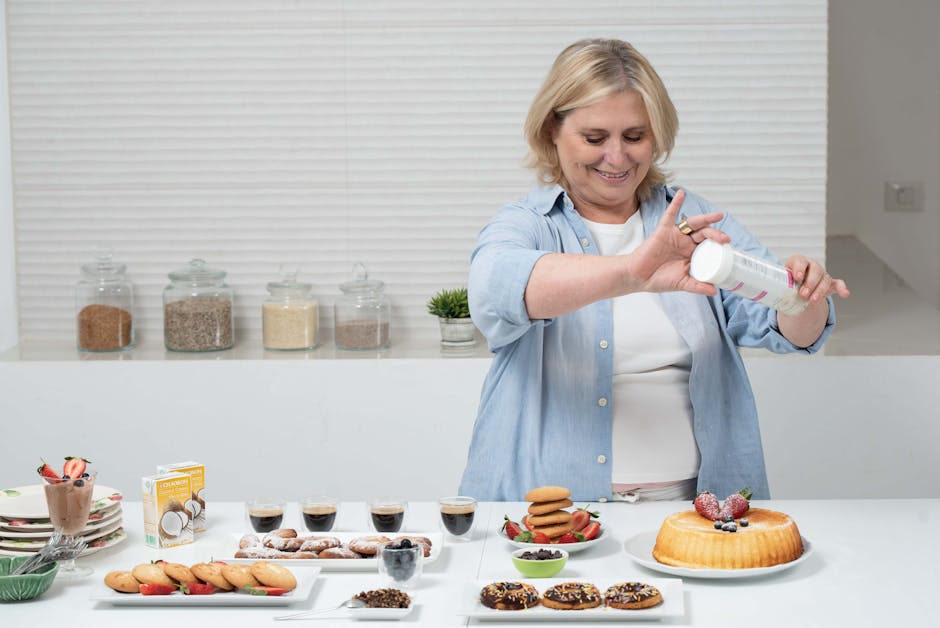
Smiling home baker decorating a cake in her kitchen
Most home bakers undercharge — not because they want to, but because they don’t know their real costs. Photo by Ronit HaNegby / Pexels

Am I Undercharging? How to Calculate the Real Cost of Your Baked Goods

“I charge $1.50 per cupcake but my ingredients alone cost $0.50. Is that enough margin?” — CakeCentral forum

Your instinct to be suspicious is right. That $0.50 ingredient cost is only the beginning. Pricing homemade baked goods correctly means accounting for every real cost, not just flour and eggs:

  • Electricity to run your oven (roughly $0.10–$0.20 per hour depending on your utility rate)
  • Packaging — boxes, tissue paper, ribbon, labels, bags
  • Your time to shop, prep, bake, decorate, box, and deliver
  • Equipment depreciation (your mixer is wearing out with every batch)
  • Gas or mileage for delivery or supply runs

Add those up and that $1.50 cupcake might actually cost $1.75–$2.00 to produce. You’re not breaking even — you’re paying your customer to let you bake for them.

The formula that works: Cost of goods + labor + overhead + profit margin = your price. Anything less and you’re subsidizing someone else’s party.

What BatterSuite does: The recipe cost calculator tracks every ingredient down to the gram. Enter your bulk purchase price (a 5 lb bag of flour at $4.99) and BatterSuite calculates the exact cost per cup, per tablespoon — whatever unit your recipe uses. No spreadsheet math. No guessing.


How to Handle Customers Who Say Your Prices Are Too High

“A customer told me my prices were ‘way out of their price range.’ Should I lower them?”

Short answer: probably not.

Bakers who lower prices to match objections almost always regret it. Here’s why: customers who push hardest on price are usually not your customers. The right buyer for handmade, high-quality cottage food is not comparison-shopping against a grocery store sheet cake.

What the complaint is actually telling you: your marketing may not be reaching the right audience yet — not that your prices are wrong.

The deeper issue: most home bakers don’t know their actual cost. They guess. So when a customer pushes back, there’s a flash of self-doubt — “Maybe I am charging too much?” — when they have no way to confirm either way. That uncertainty is the real problem.

What BatterSuite does: When your price is built from real numbers — ingredients + labor + overhead + margin — you can stand behind it confidently. You’ll know exactly what you need to charge to be profitable, and you can stop second-guessing yourself every time someone balks at the price.

Home baker reviewing pricing documents and cost formulas at a desk
Knowing your exact costs transforms pricing from guesswork into confidence. Photo by Leeloo The First / Pexels

How to Calculate Your Hourly Rate as a Home Baker

“I spent 6 hours on a custom cake, charged $80, and realized I made $13/hour before expenses. How do I set a rate that actually makes sense?” — r/Baking

This is one of the most common questions in cottage food and side hustle communities — and one of the most important to get right. Here’s a starting framework for how to calculate your hourly rate as a home baker:

  1. Set your target income. What do you need or want to earn per month from baking?
  2. Estimate your real capacity. How many actual hours per week can you bake, prep, deliver, and run admin?
  3. Divide target by hours. That’s your minimum effective hourly rate.
  4. Layer in overhead. Supplies, insurance, packaging, marketing — these come out of every hour you work.

If your math says you need $35/hour but your local market supports $20/hour, that’s critical information. It means you may need to find higher-margin products, reduce input costs, or be honest about what this business can realistically earn right now.

What BatterSuite does: Set your labor rate once and it’s automatically factored into every recipe and quote. Change it anytime — everything updates instantly. You can also compare products side by side to see which ones are worth your time and which ones are costing you money.


How to Adjust Your Baked Goods Prices When Ingredient Costs Rise

“Egg prices went through the roof. How do I raise prices without losing my customers?”

This hit hard in 2025. Egg prices spiked over $5/dozen in many parts of the country due to widespread avian flu outbreaks — and bakers who hadn’t updated their pricing absorbed those losses themselves.

The business reality is simple: if your costs go up and your prices stay flat, your margin disappears. Every dollar in extra ingredient cost you absorb is a dollar less you’re paying yourself.

How successful home bakers handle ingredient price spikes:

  • Communicate transparently with regulars. A short note — “ingredient costs have increased, so I’ve adjusted my pricing slightly” — lands better than a silent price jump.
  • Price slightly above current cost. Build a small buffer so you’re not immediately underwater the next time something spikes.
  • Raise prices before you have to, not after. Reactive price increases feel larger and more urgent to both you and your customers.

What BatterSuite does: Update an ingredient cost once in your ingredient library and every recipe using that ingredient recalculates automatically. You’ll see immediately which products are now unprofitable and by exactly how much — without touching a single spreadsheet.

Overhead view of a pricing calculator and business cost documents on a desk
One ingredient price change should update everything — not send you back to the spreadsheet. Photo by Leeloo The First / Pexels

Why Home Bakers Break Even on Big Orders — and How to Stop It

“I just finished a huge holiday order and barely broke even. What did I miss?”

This is the post-mortem almost every home baker writes at some point. Big orders look profitable up front and feel devastating afterward. Here’s what almost always gets missed:

  • Shopping time — driving to three stores to find specialty sprinkles is unpaid time unless you price for it
  • Packaging — boxes, ribbon, tissue, labels, and bags add up fast on large orders
  • Utilities — 8 hours of oven use across a big holiday batch is a real line item
  • Custom design time — the hour you spent sketching the cake design before you ever touched flour
  • Admin time — emails, revisions, payment follow-ups, scheduling

Most bakers track ingredients well. Almost none track the full picture. And the full picture is where the profit lives.

What BatterSuite does: The overhead allocation feature lets you define your fixed and variable costs — utilities, average packaging, insurance, supplies — and BatterSuite distributes that overhead across orders automatically. You see your true margin before you take the order, not after you finish it.


How to Charge What Your Baked Goods Are Worth (Without the Guilt)

This question rarely gets posted publicly. It shows up in private Facebook groups and baker DMs: I feel guilty charging full price for something I love doing.

It’s real, and it’s common, and it quietly destroys more baking businesses than any pricing formula ever will.

A few reframes that have helped other home bakers:

  • Your skill took years to develop. You’re not charging for “just a cake.” You’re charging for everything you learned to make that cake possible.
  • Undercharging doesn’t signal humility — it devalues the craft for every baker in your community.
  • If you burn out making nothing, the thing you love becomes a source of stress instead of joy. Sustainable pricing protects the work, not just the business.

The bakers who thrive long-term learn to separate their emotional relationship with the work from the financial reality of running a business. Both can exist. They just can’t share the same spreadsheet cell.

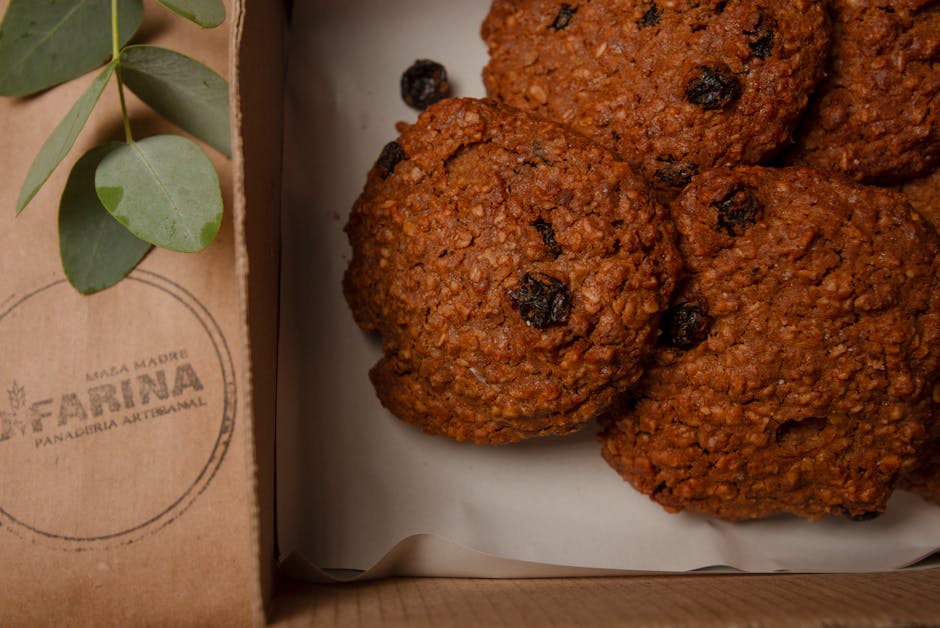
Artisanal homemade cookies packaged in a bakery box ready for delivery
Your time, skill, and ingredients all have real value. Packaging it correctly starts with knowing your real costs. Photo by Natalia Olivera / Pexels

Home Baker Pricing Software: Managing Your Bakery Business as One Person

“Is there an easier way to manage all of this? I’m just one person.”

Yes — and it’s exactly why BatterSuite was built.

Most home bakers are running their business across a patchwork of Notes apps, Google Sheets, Instagram DMs, and mental math. It works — right up until it doesn’t. Until an order gets lost. Until you can’t remember what you charged a customer last year. Until tax season hits and you have no idea what your actual revenue was.

BatterSuite is home baker pricing software that brings everything into one place:

  • Recipe cost calculator — build your recipes, track every ingredient cost, see cost of goods instantly
  • Pricing tool — set your labor rate and profit margin, get a price that actually works for your business
  • Order management — track orders from inquiry to delivery, never lose a detail
  • Client records — every customer, every order, every conversation, organized in one place
  • Gift certificates — sell and redeem gift certificates built right in
  • Loyalty program — reward repeat customers automatically

At $22.99/month (or $199/year — less than $17/month), BatterSuite is built specifically for the scale of a cottage food or home bakery operation. Not a bloated restaurant POS. Not a generic invoicing tool. Something made for bakers, by people who understand how this business actually works.

Try BatterSuite Free for 30 Days →


The Bottom Line: Profitable Home Baking Starts with Real Numbers

The home bakers building sustainable businesses aren’t necessarily the most talented. They’re the ones who took pricing seriously, learned their real costs, and stopped guessing.

Every question above is the same question in a different shape: how do I know if I’m making money? And the answer is the same every time — you need real numbers to make real decisions. A gut feeling isn’t a pricing strategy.

BatterSuite gives you those numbers, automatically, so you can focus on the baking.

Start Your Free 30-Day Trial


Frequently Asked Questions About Home Baker Pricing

What is a good profit margin for a home bakery?

Most cottage food and home bakery businesses aim for a 30–50% profit margin after accounting for ingredients, labor, and overhead. Many bakers start far below this because they don’t include labor or overhead in their pricing at all. A recipe cost calculator helps you identify your true margin before you set a price.

How do I calculate the cost of a homemade cake?

Add up the cost of every ingredient (down to tablespoon-level precision), add packaging costs, calculate your time at your labor rate, and add a share of your monthly overhead (utilities, insurance, supplies). That total is your cost of goods. Your price should be your cost plus your desired profit margin.

Should I charge for my time as a home baker?

Yes — always. Your time is the most expensive ingredient in almost every recipe. Experienced bakers charge anywhere from $15 to $50+ per hour depending on skill level, local market, and product complexity. Many home bakers start undercounting their hours and gradually build toward a rate that reflects the real value of their work.

What’s the best software for home baker pricing?

BatterSuite is built specifically for home bakers and cottage food businesses. Unlike generic invoicing tools or restaurant POS systems, it’s designed around the way home bakers actually work — recipe-based costing, per-order pricing, client tracking, and order management in one place.

How do I handle ingredient price increases as a home baker?

Update your ingredient costs in your pricing tool as soon as prices change, then review which products are no longer hitting your margin target. It’s better to raise prices proactively with a brief note to regular customers than to wait until you’re losing money on every order.


Have a pricing question we didn’t cover? Drop it in the comments — we read every one.

Images sourced from Pexels (free to use). Photo credits: Ronit HaNegby, Leeloo The First, Natalia Olivera.

[...]

Stop Undercharging: Why Most Home Bakers Price Too Low (And How to Fix It)

February 17, 2026
by marciadex
Blog, , ,

Calculator and pricing documents on desk - business planning

You spent three hours decorating those cookies. You used premium ingredients. You poured your heart into every detail.

And then you charged $30 a dozen.

Sound familiar?

If you’ve ever looked at your bank account after a big order and wondered where all the profit went, you’re not alone. Most home bakers are undercharging — not because they don’t value their work, but because they genuinely don’t know what their products actually cost to make.

The Real Reason You’re Undercharging

It’s not lack of confidence (though that doesn’t help). It’s not imposter syndrome (though many of us deal with that too).

The real reason? You’re guessing.

You’re eyeballing ingredient costs. You’re not tracking your time. You’re forgetting about packaging, utilities, and all those “little” expenses that add up fast. You’re looking at what other bakers charge and hoping you’re in the right ballpark.

And when someone questions your price? You panic and lower it.

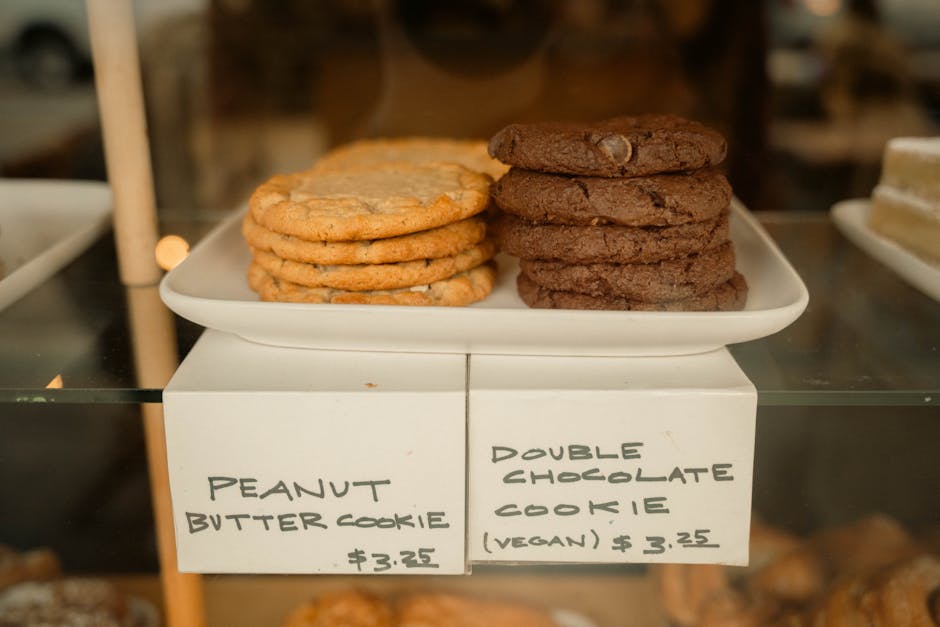
Display of cookies in bakery shop

What Actually Goes Into Pricing

Let’s talk about what you’re REALLY selling when someone orders a dozen custom cookies:

Ingredients: Butter, flour, sugar, food coloring, flavoring extracts — every single item has a cost, and it adds up faster than you think.

Time: Shopping for supplies, mixing dough, baking, cooling, decorating, boxing, communicating with the customer. That’s not just “a few hours” — that’s skilled labor that deserves to be compensated.

Overhead: Electricity to run your oven. Water for washing dishes. Packaging materials. Business insurance. Website hosting. These aren’t optional — they’re the cost of running a legitimate business.

Expertise: You didn’t learn to bake overnight. Your skills, your recipes, your ability to turn someone’s Pinterest dream into reality — that has VALUE.

The $45 Dozen That Actually Costs $52

Here’s a real example from my own bakery:

I was charging $45/dozen for simple decorated cookies. Seemed fair, right? Competitive with other local bakers. Customers weren’t complaining.

Then I actually calculated the costs:

  • Ingredients: $18.50
  • Packaging: $4.20
  • Labor (3 hours at $20/hr): $60
  • Overhead allocation: $6.30
  • Total actual cost: $89

I was losing $44 per order. And wondering why I was always stressed about money.

Sound familiar?

Pricing formula document with laptop and calculator

Why “Competitive Pricing” Is Keeping You Broke

Here’s what I see all the time in baker Facebook groups:

“What should I charge for a dozen cookies?”

And everyone chimes in with their prices. $25. $35. $40. Maybe $50 if you’re fancy.

But here’s the problem: their costs aren’t your costs.

Maybe they buy ingredients in massive bulk. Maybe they already own professional equipment. Maybe they’re not factoring in their time because they consider baking a “hobby.”

When you price based on what others charge instead of what YOU need to charge to be profitable, you’re building a business on quicksand.

The Confidence That Comes From Knowing Your Numbers

Everything changed when I started actually tracking my costs.

Not guessing. Not estimating. Actually calculating.

Suddenly, I could look a customer in the eye and say, “That’s $72 a dozen” without flinching. Because I knew exactly where that number came from. I knew my profit margin. I knew I wasn’t losing money.

And you know what? My sales didn’t drop. In fact, they increased.

Because confidence is attractive. When you know your worth, customers trust your pricing.

You Need a System, Not Just a Spreadsheet

I tried the Excel spreadsheet thing. I really did.

But here’s what happened: I’d update one ingredient cost and forget to update it in three different tabs. I’d lose track of which version was current. I’d spend 20 minutes hunting for the right file.

What I needed was a system that:

  • Calculated costs automatically
  • Updated everything when I changed one number
  • Was easy to access and actually USE
  • Didn’t require a degree in spreadsheets

So I built one. And now I’m giving it to you.

Introducing the Sweet Start Pricing Kit

This is the exact system I use in my own bakery to price every single product.

It’s a Notion template (don’t worry, Notion is free and super easy to use) that includes:

✅ Ingredient Cost Calculator
Track every ingredient you use, what you paid for it, and how much each recipe actually costs. No more guessing. No more “close enough.”

✅ Automatic Cost Calculations
Enter your ingredient amounts once, and the template does the math for you. Update a price, and everything recalculates instantly.

✅ Customizable Database
Add your own ingredients, your own recipes, your own costs. This isn’t a one-size-fits-all template — it’s designed to work for YOUR business.

Hands organizing business documents and pricing papers

What You’ll Be Able to Do

After you set up this pricing kit (takes about 15 minutes), you’ll be able to:

  • Calculate the exact cost of any recipe in seconds
  • Know your minimum price before you even talk to a customer
  • Adjust for ingredient price changes without panic
  • See which products are actually profitable (spoiler: it might not be what you think)
  • Quote prices with total confidence
  • Stop leaving money on the table

This Is Your Business. Treat It Like One.

You wouldn’t walk into Target and negotiate the price of milk, right?

So why are you letting customers negotiate YOUR prices?

It’s because you’re not sure. You don’t have the numbers to back you up. You’re afraid they’ll think you’re too expensive.

But here’s the truth: Professional businesses have professional prices.

And professional prices are based on actual costs, not guesswork and fear.

Ready to Stop Guessing and Start Profiting?

The Sweet Start Pricing Kit is completely free. No credit card. No catch. Just a genuine tool to help you run a more profitable bakery.

Because I’m tired of seeing talented bakers burn out because they can’t make the numbers work. I’m tired of watching incredible artists undervalue their work. I’m tired of the “race to the bottom” pricing that keeps all of us struggling.

You deserve to make money doing what you love.

Let’s make that happen.

Get Your Free Pricing Kit Now →

What happens next: Click the button above, enter your email, and you’ll instantly receive your Sweet Start Pricing Kit. It takes about 15 minutes to set up, and then you’ll have a pricing system you can use forever. No commitment. No upsells. Just a tool to help you charge what you’re worth.

See you on the other side of undercharging,

Marcia
Founder, SweetTube Academy
Owner, Marcia’s Micro-Bakery

P.S. — Still not sure? Reply to the welcome email after you download and tell me your biggest pricing struggle. I read every message and I’ll help you figure it out.

[...]

Master Holiday Cake Decorating: Your Complete Guide to Festive Baking Success

November 14, 2025
by marciadex
Holiday Baking, Tutorials, ,

Learn professional holiday cake decorating techniques with SweetTube Academy. Master festive designs, buttercream techniques, piping skills, fondant work, and color theory for Christmas, Hanukkah, and winter cakes. Includes trending 2025 designs, essential tools, troubleshooting tips, and membership options ($5-$9/month). Transform your holiday baking!

[...]