
What Is a Fair Hourly Rate for a Home Baker?

March 27, 2026
by marciadex
Pricing and Profitability, , , , ,

Of all the pricing decisions a home baker makes, the hourly rate is the most important โ€” and the most likely to be set too low.

Many bakers pick a number that feels “reasonable” without much thought. Others charge nothing at all for their time, treating labor as free. Both approaches guarantee underpricing.

Here’s how to think about your hourly rate the right way.


Why Your Hourly Rate Is the Most Important Pricing Variable

Ingredients have fixed costs. Overhead is relatively predictable. But labor โ€” your time โ€” is the largest variable in most custom baking orders, and it varies dramatically by product and skill level.

A sheet cake might take 1.5 hours. An elaborate tiered wedding cake might take 12 hours. If your hourly rate is wrong, every price you set is wrong.

Getting this number right is the foundation of a profitable pricing strategy.


What Most Home Bakers Actually Charge Themselves

Most bakers significantly undervalue their labor. Common mistakes:

  • Charging $10 to $12 per hour because it “feels like enough”
  • Charging nothing for labor and hoping ingredient markup covers it
  • Basing their rate on what minimum wage is, rather than what their skill is worth
  • Forgetting to count all the time โ€” not just active decorating, but prep, cleanup, customer communication, and packaging

The result: bakers work 30 to 40 hours a week and earn less than they would at a part-time retail job.


The Right Way to Set Your Hourly Rate

Your hourly rate should reflect three things.

What Your Skill Is Worth

Home baking is a skilled trade. The ability to produce consistent, beautiful, safe-to-eat baked goods takes years to develop. Custom cake decorating is an art form that people pay premiums for.

Compare your skill level to what professional pastry chefs earn:

  • Entry-level pastry cook: $15 to $18 per hour
  • Experienced pastry chef: $20 to $30 per hour
  • Specialty decorator / custom cake artist: $25 to $45 per hour

You are not an entry-level employee. Set your rate accordingly.

What You Need to Earn

Work backwards from what you want or need your baking to contribute financially.

Example:

  • Goal: earn $1,500 per month from baking
  • Available baking hours: 20 per week, 80 per month
  • But not all hours are billable โ€” some go to admin, social media, planning
  • Realistic billable hours: approximately 60 per month
  • Required rate: $1,500 divided by 60 = $25 per hour minimum

If your current rate is $12 per hour, you’d need to work 125 hours to hit the same goal โ€” more than 3 times the work.

What the Market Supports

Your rate needs to be sustainable in your local market. If you’re in a high cost-of-living area (northern NJ, NYC suburbs), customers expect to pay more and your rate can reflect that. Rural markets may have lower price tolerance.

Research what custom cake bakers in your area charge โ€” not per item, but by working backward from their prices to estimate their implied hourly rate.


A Starting Rate Framework

New baker (under 1 year selling): $15 to $18 per hour
Established baker (1 to 3 years): $18 to $25 per hour
Experienced with strong portfolio: $25 to $35 per hour
Specialty or advanced decorator: $35 to $50 per hour

These are starting points, not ceilings. Raise your rate as your demand grows, your skills improve, or when you’re consistently booked out.


What Hours to Count

Your billable hours include:

Direct baking time:

  • Mixing, baking, cooling
  • Filling and stacking layers
  • Crumb coating and chilling
  • Final frosting and decorating
  • Assembly and finishing

Support time:

  • Grocery shopping specifically for an order (prorate by order)
  • Packaging and boxing
  • Customer consultation and communication related to that order
  • Delivery or setup time

What you can reasonably exclude:

  • General business administration (unless it’s order-specific)
  • Marketing and social media
  • Passive waiting time when the oven is running and you’re doing other things

Track your time for a few orders and you’ll almost certainly find you’re spending 20 to 30 percent more time than you estimated.


Running the Numbers: A Real Example

Order: Custom 2-tier birthday cake, buttercream finish, hand-painted florals

Time breakdown:

  • Baking (3 layers) + cooling: 2.5 hours
  • Filling, stacking, crumb coat + chill: 1 hour
  • Final frosting + smoothing: 45 minutes
  • Hand-painted florals: 2 hours
  • Packaging and customer communication: 30 minutes
  • Total: 6.75 hours

At $15 per hour: $101.25 in labor
At $22 per hour: $148.50 in labor
At $30 per hour: $202.50 in labor

Add ingredients ($30 to $40) and overhead ($8 to $12), and the price difference between a $15 per hour baker and a $30 per hour baker is about $100 on the same cake.

That $100 is the difference between profitability and barely breaking even.


When to Raise Your Rate

Raise your hourly rate when:

  • You’re consistently booked out 3 or more weeks in advance
  • You’re turning away orders because you don’t have capacity
  • Your skills have meaningfully improved (new techniques, better consistency)
  • Ingredient and supply costs have increased
  • You haven’t raised your rate in 12 or more months

You don’t need to announce a rate increase dramatically. Just apply the new rate to new orders going forward. Loyal customers rarely object to modest, infrequent increases โ€” especially if your quality is consistent.


The Mindset Shift That Changes Everything

Many bakers resist charging a fair rate because they feel guilty. “I love baking,” or “I don’t want to price people out.”

Here’s the reframe: charging fairly for your time is what allows you to keep doing this. When bakers underprice, they burn out, resent orders, and eventually stop. When they price correctly, they build sustainable businesses that last.

Your customers want you to still be in business next year. Charge what it takes to make that possible.


Tools That Make Labor Tracking Easier

BatterSuite’s Pricing Calculator lets you set your hourly rate once and apply it to every order automatically. You enter the estimated hours, and the tool calculates labor cost as part of the full price โ€” alongside ingredients and overhead.

No manual math. No forgotten hours. Just a price you can quote with confidence.

Try BatterSuite free for 30 days at battersuite.com.

For a deeper dive into pricing strategy, SweetTube Academy’s pricing courses walk through the full methodology โ€” from ingredient costing to setting your market-appropriate rate.

Browse baking business courses at sweettubeacademy.com.


Written by Marcia Dexter, founder of SweetTube Academy and owner of Marcia’s MicroBakery in Beachwood, NJ.

[...]
How to Track Your Baking Equipment for Tax Purposes

March 26, 2026
by marciadex
Business Finance and Taxes, , , , ,

Your KitchenAid stand mixer. Your set of professional cake pans. Your offset spatulas, turntable, fondant tools, piping tips. Your commercial-style oven.

These are business assets โ€” and if you’re running a home bakery as a real business, they’re tax-deductible. Most home bakers either don’t know this, don’t track it, or track it incorrectly and miss deductions they’re entitled to.

Here’s how to do it right.


Track Your Baking Equipment

When you operate a legitimate home bakery business โ€” with income you report and a business structure in place โ€” your equipment purchases are business expenses that reduce your taxable income.

The more accurately you track these expenses, the lower your tax bill. For a baker who has invested $3,000 to $8,000 or more in equipment over time, this is real money.

There are two ways to deduct equipment: immediate expensing (Section 179) or depreciation (spreading the deduction over the useful life of the asset). The right approach depends on the item and your tax situation. A tax professional can advise on which makes sense โ€” but you need good records either way.


What Counts as Deductible Equipment

For a home bakery, deductible equipment includes any item used primarily for your baking business.

Large equipment:

  • Stand mixer
  • Food processor
  • Commercial-grade oven or oven accessories
  • Dehydrator
  • Refrigerator or freezer (if used primarily for the business)
  • Chest freezer

Bakeware and tools:

  • Cake pans, tart pans, loaf pans, springform pans
  • Sheet pans and half-sheet pans
  • Cooling racks
  • Turntable (decorating)
  • Bench scraper, offset spatulas, smoothers
  • Piping bags, tips, couplers
  • Fondant tools and cutters
  • Rolling pins, mats, guides

Packaging and presentation:

  • Cake boxes and boards (consumable โ€” expensed immediately)
  • Display stands, risers, serving platters used at markets

Technology:

  • Tablet or iPad used for recipes and order management
  • Printer for labels and invoices
  • Camera used primarily for food photography

Software subscriptions:

  • BatterSuite or other bakery management software
  • Photo editing software
  • Email marketing tools

Partially deductible items: A laptop or phone used for both personal and business purposes can be deducted proportionally. If you use your phone 40% for business, 40% of the cost and plan is deductible.


How to Track Equipment (The Right Way)

Step 1: Create an Equipment Inventory

Start a master list of everything you use for your baking business. For each item, record:

  • Item name and description
  • Date purchased
  • Purchase price (original cost)
  • Where you bought it (store or online)
  • Proof of purchase (receipt, bank statement, order confirmation)

If you’ve been baking for a while and never tracked this, go back through bank statements and credit card history. You can still document and depreciate equipment you purchased in previous years โ€” a tax professional can help with this.

Step 2: Save Every Receipt

For future purchases, save every receipt โ€” digital or physical. The easiest system: create a folder in Google Drive or Dropbox labeled “Bakery Equipment Receipts” and photograph or save every receipt immediately after purchase.

For online purchases, forward order confirmation emails to a dedicated business email folder.

Step 3: Categorize by Type

For tax purposes, equipment generally falls into a few categories:

  • Consumables (packaging, piping bags, parchment paper) โ€” expensed in the year purchased
  • Small equipment under approximately $2,500 โ€” typically expensed immediately under simplified rules
  • Large equipment over $2,500 โ€” may be depreciated over 5 to 7 years (or immediately expensed under Section 179)

Your tax professional will confirm the current thresholds and what makes sense for your situation.

Step 4: Track Annual Additions

At the start of each year, update your equipment list with everything purchased in the prior year. This becomes part of your annual tax documentation.


Using IcingVault to Track Your Bakery Equipment

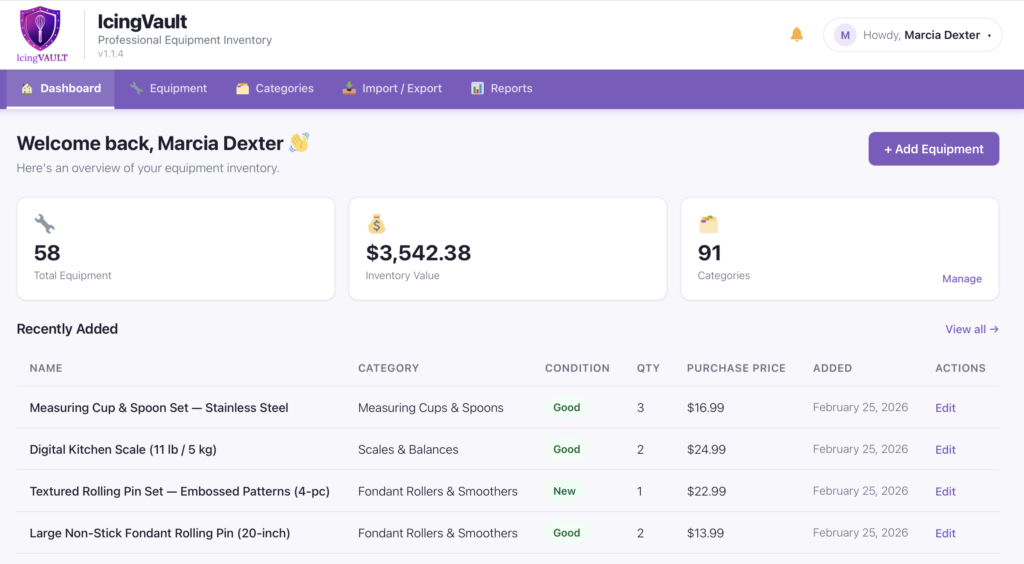
IcingVault is a bakery equipment inventory management tool built specifically for home and small commercial bakers โ€” and it’s part of the SweetTube Academy platform.

IcingVault lets you:

  • Log every piece of equipment with purchase date, cost, and condition
  • Track depreciation over time
  • Note warranty information and maintenance history
  • See the full value of your equipment inventory at a glance
  • Export records for tax documentation

Instead of maintaining a manual spreadsheet, IcingVault gives you a dedicated home for your baking equipment records โ€” so when tax season comes, the information is already organized.

Learn more about IcingVault at sweettubeacademy.com/icingvault.


Home Office and Kitchen Deductions

If you use part of your home exclusively for your baking business, you may also be able to deduct:

Home office and kitchen deduction: The IRS allows a deduction for the portion of your home used regularly and exclusively for business. For a home baker, this is typically a dedicated workspace or portion of your kitchen.

The simplified method allows $5 per square foot of dedicated business space, up to 300 square feet ($1,500 maximum). The regular method calculates the actual percentage of home expenses (mortgage or rent, utilities, insurance) attributable to the business space.

Utilities: The portion of your gas and electric bill attributable to business baking is deductible. Keep records of high-use months and, if possible, track when you’re baking for orders versus personal use.


Common Mistakes to Avoid

Not keeping receipts. The IRS requires documentation for every deduction. “I remember buying it” is not documentation.

Mixing personal and business purchases. Use a dedicated business bank account and credit card. This makes tracking automatic and audit-proof.

Forgetting software subscriptions. Monthly subscriptions like BatterSuite, Canva, or Adobe are fully deductible business expenses โ€” and easy to forget.

Claiming 100% of dual-use items. A laptop or phone you use personally and for business must be prorated. Claiming 100% is a red flag.

Not talking to a tax professional. Home bakery taxes have nuances โ€” home office deductions, self-employment tax, quarterly estimated payments. A one-time consultation with a CPA who understands small food businesses is worth it.


A Simple Year-End Checklist

Every December or early January, do this:

  • Update your equipment inventory with all new purchases
  • Download and organize all receipts for the year
  • Calculate total equipment purchases by category
  • Log all software and subscription costs
  • Note any baking equipment disposed of, sold, or retired
  • Compile for your tax professional or tax software

The more organized your records are going in, the less time (and money) you spend on taxes coming out.


Written by Marcia Dexter, founder of SweetTube Academy and owner of Marcia’s MicroBakery in Beachwood, NJ.

This post is for informational purposes only and does not constitute tax advice. Consult a qualified tax professional for guidance specific to your situation.

[...]

How to Start a Home Bakery Business in New Jersey

March 25, 2026
by marciadex
Cottage Food Laws and Licensing, , , , ,

New Jersey has some of the most specific cottage food rules in the country โ€” and understanding them before you take your first paid order can save you a lot of headaches down the road.

This guide covers what you can legally sell, where you can sell it, how to register your business, and how to get started the right way.


What Is a Cottage Food Business?

A cottage food business is a food business operated out of a private home kitchen. Instead of requiring a commercial kitchen, cottage food laws allow home bakers and other food producers to prepare and sell certain low-risk foods directly to consumers.

New Jersey’s cottage food law is governed by the New Jersey Cottage Food Industry Act, which was updated in recent years to expand what’s allowed.


What Foods Can You Sell Under NJ Cottage Food Law?

New Jersey permits the sale of non-potentially-hazardous foods made in a home kitchen. These are foods that don’t require refrigeration to remain safe.

Permitted foods typically include:

  • Baked goods (cookies, cakes, cupcakes, muffins, breads, pies with shelf-stable fillings)
  • Jams and jellies
  • Candy and confections
  • Dry mixes

Foods generally not permitted under cottage food rules:

  • Items requiring refrigeration (cream cheese frosting, mousse fillings, fresh fruit fillings)
  • Meat products
  • Canned goods (with some exceptions for high-acid foods)

A note on frosting: Most standard buttercream frosting (made with butter and powdered sugar) is considered shelf-stable and is generally permitted. Cream cheese frosting is not. When in doubt, check with your local health department.


Where Can You Sell in New Jersey?

Under NJ cottage food law, you can sell:

  • Direct to consumers โ€” at farmers markets, craft fairs, community events, and from your home
  • Online โ€” with direct-to-consumer delivery or pickup (this was expanded in recent legislation)

You generally cannot:

  • Sell wholesale to grocery stores or restaurants
  • Sell through third-party platforms that handle the transaction and shipping (rules vary โ€” check current law)

Sales must be made directly between you and the customer. Confirm current rules with your county health department before listing on any third-party platform.


Do You Need a License to Sell Baked Goods in NJ?

Yes โ€” New Jersey cottage food sellers are required to register with their local health department (county or municipality, depending on where you live). This is different from a full commercial kitchen license and is typically straightforward.

The registration process usually includes:

  1. Contacting your county health department to request cottage food registration
  2. Completing a registration form and paying a small fee (varies by county, typically $30 to $100)
  3. A possible home inspection (requirements vary by county)
  4. Annual renewal

Some counties are more involved than others. Bergen County, Monmouth County, and Ocean County (where Beachwood is located) each have their own process. Call your local health department โ€” they’re usually helpful.


Labeling Requirements

Every product you sell must be labeled according to NJ law. Required label information includes:

  • Product name
  • Your name (as the producer)
  • Your home address (or registered business address)
  • Ingredients (listed in descending order by weight)
  • Net weight or count
  • Allergen disclosure (if applicable โ€” nuts, gluten, dairy, eggs, soy, etc.)
  • The statement: “Made in a home kitchen that is not inspected by the New Jersey Department of Agriculture or local health department.”

This disclaimer is required by law. It must appear on every product label.

You can print labels at home using Avery label templates or order custom labels from a local printer. Canva has free templates that work well for cottage food packaging.


Do You Need a Business License?

Separate from your cottage food registration, you may also need:

Business registration with the State of NJ: If you’re operating as a sole proprietor under your own name, formal registration may not be required. If you’re operating under a business name (like “Marcia’s Micro-Bakery”), you’ll need to file a Business Registration Certificate with the NJ Division of Revenue. This is done online at njportal.com and costs around $125 for an LLC.

EIN (Employer Identification Number): Even as a sole proprietor with no employees, getting a free EIN from the IRS is recommended. It keeps your business finances separate from personal and is needed for certain bank accounts and tax filings.

Sales tax: Baked goods sold in NJ are generally exempt from sales tax when sold for human consumption. Confirm with a tax professional for your specific situation.


Setting Up Your Home Bakery: Practical Steps

Once you understand the legal side, here’s how to get your home bakery operational:

  1. Check your homeowner’s or renter’s insurance. Standard policies typically don’t cover home-based food businesses. Look into a home baker business insurance policy (FLIP and InsureMyFood are popular options; $299 to $500 per year).
  2. Open a separate business bank account. Keep business income and expenses completely separate from personal. This simplifies taxes enormously.
  3. Get your pricing right before you start taking orders. Calculate true cost (ingredients + labor + overhead) so you’re profitable from day one. SweetTube Academy has a full pricing course that walks through this.
  4. Set up an order management system. A spreadsheet works to start, but as you grow you’ll want dedicated software like BatterSuite to track quotes, orders, deposits, and invoices.
  5. Build your menu. Start with your best 5 to 8 items. A focused menu is easier to cost, price, and market than trying to offer everything.
  6. Create a simple online presence. At minimum, an Instagram account and a way for customers to contact you. A basic website or storefront comes next.

Resources for NJ Home Bakers

  • NJ Department of Health โ€” for cottage food registration information by county
  • NJ Division of Revenue (njportal.com) โ€” business registration
  • IRS.gov โ€” free EIN application
  • SweetTube Academy โ€” courses on pricing, business setup, and tools for home bakers
  • BatterSuite โ€” bakery management software built for cottage food businesses

The Bottom Line

Starting a home bakery in New Jersey is very doable. The cottage food law gives you a legitimate path to sell directly to customers without a commercial kitchen. The key steps: register with your county health department, label everything properly, price your products correctly, and set up basic business infrastructure before you start taking orders.

Getting the foundation right from the beginning makes everything else easier.


This post is for informational purposes only and reflects our best understanding of NJ cottage food law as of early 2026. Laws change โ€” always verify current requirements with your local health department before starting your business.

Written by Marcia Dexter, founder of SweetTube Academy and owner of Marcia’s MicroBakery in Beachwood, NJ โ€” a licensed NJ home bakery.

[...]

Do Home Bakers Need Real Business Software?

March 24, 2026
by marciadex
Business Tools, , , , ,

Every home bakery starts the same way: a notes app for orders, a spreadsheet for ingredients, Venmo for payments, and a mental calendar for due dates.

For a while, it works fine. Then it doesn’t.

The question isn’t whether you’ll eventually need better systems โ€” it’s when. And the answer is usually: sooner than you think.


The Spreadsheet Phase Is Normal

There’s nothing wrong with starting with a spreadsheet. It’s free, flexible, and most people already know how to use it.

A well-built spreadsheet can handle:

  • Basic order tracking
  • Simple recipe costing (if you set it up carefully)
  • Revenue and expense logging

If you’re taking 3 to 5 orders a month and have no plans to grow significantly, a spreadsheet might genuinely be all you need.

But most bakers who are asking “do I need software?” are past this phase.


Signs You’ve Outgrown Your Spreadsheet

These are the signs that informal tools are costing you time, money, or customers:

You’ve forgotten about an order โ€” even once. A system that lets orders fall through is a system that’s already too complex for your tools.

Pricing takes more than 5 minutes per order. If you’re manually calculating ingredient costs and labor every time, you’re spending time that should go toward baking.

You don’t know if you’re profitable. If you can’t answer “how much did I actually earn last month, after costs?” without significant digging, your financial tracking isn’t working.

You’re taking payment at pickup. This usually means invoicing is an afterthought โ€” which means some customers show up without cash, some overpay or underpay, and you have no record.

Customer info is spread across texts, DMs, and memory. When a repeat customer orders again and you can’t instantly see their history, you’re leaving repeat business to chance.

You’re booking from memory. If you’ve ever double-booked or come close to it, your calendar system needs work.

You’re spending more time on admin than on baking. When the business side crowds out the actual baking, something has to change.


What Real Business Software Does Differently

The difference between a spreadsheet and purpose-built software isn’t just convenience โ€” it’s capability.

Automatic recipe costing. Change one ingredient price and every recipe updates. No manual recalculation.

Quote and order workflow. Send a professional quote, convert it to an order when accepted, track the deposit, generate the invoice โ€” all in one flow.

Online payment collection. Customers pay before pickup. You don’t handle cash. Your records update automatically.

Customer records. Every order attached to a customer profile. Allergies, preferences, and order history always visible.

Production calendar. See all upcoming orders in one view, with bake dates calculated from due dates.

Business reporting. Revenue, expenses, and profit โ€” without building your own formulas.

Email marketing. Birthday reminders, seasonal promotions, and follow-ups sent from the same platform where you manage orders.

A spreadsheet does none of these things โ€” not because spreadsheets are bad, but because they weren’t designed for this workflow.


What to Look for in Bakery Software

Not all bakery software is the same. When evaluating tools, look for:

Built for home and cottage bakers specifically. Most business software assumes a storefront, staff, or commercial kitchen. Software built for home bakers understands custom orders, cottage food constraints, and the one-person workflow.

Recipe costing built in. If the software doesn’t handle ingredient-level costing, you’ll still be doing that work manually.

Integrated payments. Look for Stripe, PayPal, or Square integration โ€” not just invoicing with no payment option.

Not overcomplicated. You don’t need enterprise features. You need the 8 to 10 things that matter for a home bakery, done well.

Reasonable price. A tool that costs more than it saves is not a good tool. For a home bakery, $15 to $25 per month is a reasonable range.


Tools Worth Knowing

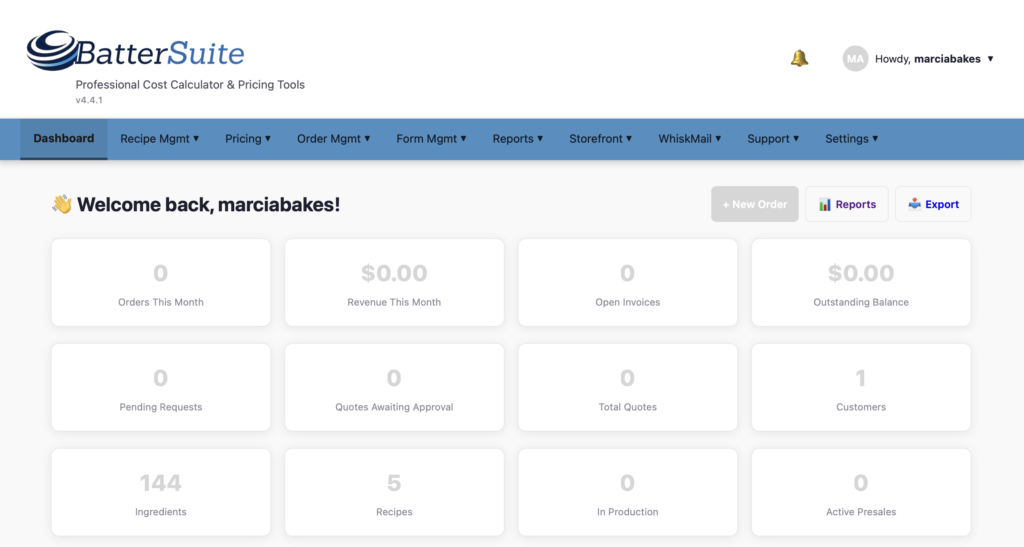
BatterSuite โ€” built specifically for home and cottage food bakers. Recipe costing, order management, CRM, invoicing with online payment, public storefront, and email marketing in one platform. $15.99 per month or $175 per year. 30-day free trial.

Dubsado and HoneyBook โ€” popular for service businesses, but not built for bakers. No recipe costing, no baking-specific fields. Overkill and underpowered at the same time for this use case.

Wave โ€” good free invoicing, but no recipe management, no order tracking, no CRM.

Google Workspace โ€” useful for documents and basic spreadsheets, but you’re still building everything yourself.

For most home bakers, BatterSuite is the only tool designed for their specific workflow.


The ROI Calculation Is Simple

BatterSuite costs $15.99 per month. If it saves you 2 hours of admin time per month โ€” conservative for a baker doing 10 or more orders โ€” that’s worth $30 to $50 at a $15 to $25 per hour labor rate.

If it helps you price one order correctly that you would have undercharged, it’s paid for itself for the year.

The question isn’t whether you can afford it. It’s whether you can afford to keep doing it the hard way.


When to Make the Switch

There’s no single right moment. But a practical guideline:

Consider switching when you’re taking 6 or more orders per month and spending noticeable time on admin tasks, or when you’ve had any order-related problems (forgotten orders, pricing mistakes, payment confusion).

Definitely switch when you’re turning down orders because you’re overwhelmed, or when your business admin is taking more time than the baking itself.

Most bakers who make the switch say they wish they’d done it sooner.


Try BatterSuite free for 30 days at battersuite.com โ€” no credit card required.

For more on building a profitable, organized home bakery, browse the courses at SweetTube Academy. We cover pricing, business setup, software tools, and more โ€” taught by a working home baker.

Browse courses at sweettubeacademy.com.


Written by Marcia Dexter, founder of SweetTube Academy and owner of Marcia’s MicroBakery in Beachwood, NJ.

[...]
Cottage Food Laws by State: The Complete Guide (2026)

March 23, 2026
by marciadex
Cottage Food Laws and Licensing, , , , ,

Cottage food laws are the legal framework that allows home bakers and other food producers to make and sell certain foods from their home kitchens โ€” without the cost or complexity of a commercial facility.

But these laws are set at the state level, and they vary enormously. What’s perfectly legal in one state can be prohibited two hours away. Before you sell a single item, you need to know your state’s rules.

This guide explains the key dimensions of cottage food law and summarizes the current framework across major states. Always verify with your state’s department of agriculture or health โ€” laws change.


The Key Dimensions of Cottage Food Law

Every state’s cottage food law can be understood across six dimensions.

  1. Permitted Foods

Most states allow non-potentially-hazardous foods (NPHF) โ€” foods that don’t require refrigeration to stay safe. This typically includes:

  • Baked goods (cookies, cakes, pies with shelf-stable fillings, breads, muffins)
  • Jams, jellies, and preserves
  • Candy and confections
  • Dry mixes and granola
  • Roasted nuts

Foods that are commonly restricted:

  • Items requiring refrigeration (cream cheese frosting, custard fillings, fresh fruit toppings)
  • Meat products
  • Raw milk products
  • Acidified or low-acid canned goods (unless following tested recipes)

Some states have expanded their permitted food lists significantly. A few (like California and Texas) allow a broad range of foods with minimal restriction.

  1. Where You Can Sell

States generally fall into a few categories:

  • Direct-to-consumer only โ€” you sell face-to-face at your home, farmers markets, fairs, and community events
  • Online and internet sales โ€” some states permit online ordering with local pickup or delivery
  • No wholesale โ€” most states prohibit selling through grocery stores, restaurants, or distributors

A handful of states now allow third-party delivery platform sales within defined limits.

  1. Revenue Limits

Many states cap annual gross sales for cottage food businesses. Common limits:

  • $5,000 per year (very restrictive โ€” limits this to a side income)
  • $25,000 per year (a real small business is possible)
  • $50,000 per year
  • No limit (increasingly common as states modernize their laws)

If you plan to grow, the revenue cap is one of the most important factors to understand.

  1. Labeling Requirements

Nearly every state requires cottage food products to carry a label with:

  • Producer name and address
  • Product name
  • Ingredients list
  • Net weight or count
  • Allergen disclosures
  • A disclaimer stating the product was made in a home kitchen not inspected by health authorities

The exact wording of the disclaimer varies โ€” your state’s department of agriculture will have the required language.

  1. Registration or Permitting

Some states require cottage food producers to register with the health department or department of agriculture. Others require no registration at all. Requirements also vary by county within states.

  1. Training Requirements

A small number of states require food safety certification (like ServSafe) as a condition of operating under cottage food law. This is worth checking โ€” courses are typically inexpensive and completed online.


State-by-State Overview

Note: This is a general summary for reference. Laws change frequently โ€” always verify current requirements with your state’s official sources.

Alabama
Permits baked goods, jams, and candies. Sales must be direct-to-consumer. Revenue cap: $20,000 per year. Registration not required.

Arizona
Broad cottage food law. Wide range of foods permitted. No revenue cap. Online sales and delivery permitted. No registration required.

California
One of the most permissive states. Two permit levels: Class A (up to $75,000 per year, direct sales only) and Class B (up to $75,000 per year, allows indirect sales like online platforms). Wide range of foods permitted. Annual registration required.

Colorado
Broad permissions, including online sales. No revenue cap. Registration not required for most producers.

Florida
Permits most non-hazardous foods. No revenue cap. Online sales permitted with direct delivery. No license required. Labeling requirements apply.

Georgia
Permits baked goods and other cottage foods. Sales at farmers markets and direct from home. Revenue cap: $50,000 per year. Registration not required.

Illinois
Cottage Food Operation Act permits most baked goods and processed foods. Sales at farmers markets, farm stands, direct from home. Revenue cap: $50,000 per year.

Michigan
Cottage food law permits most shelf-stable foods. Revenue cap: $25,000 per year. Must label with required statement.

New Jersey
Cottage food sellers must register with their county health department. Permitted foods include most baked goods and shelf-stable items. Online sales to direct customers permitted. Labeling requirements include specific NJ disclaimer language.

New York
New York Cottage Food Law permits baked goods and other NPHF foods. Revenue cap: $60,000 per year. Sales at farmers markets and direct from home. Annual registration with the state required.

North Carolina
Permits a wide range of foods. Revenue cap: $20,000 per year. Sales only at farmers markets, roadside stands, and direct from home. Registration not required.

Ohio
Permits most baked goods and cottage foods. Revenue cap: $35,000 per year. Registration not required. Labeling requirements apply.

Pennsylvania
Limited cottage food law. Baked goods and some processed foods permitted. Home-based operations must meet home food safety standards. Check county-level requirements.

Texas
One of the broadest cottage food laws in the country. Very wide range of foods permitted. No revenue cap. Online sales and third-party delivery platforms permitted. No license or registration required.

Virginia
Cottage Food Production Operation law permits a range of foods. Revenue cap: $35,000 per year. Sales direct-to-consumer at markets and events. Registration not required.

Washington
Permits most cottage foods. No revenue cap. Registration and permitting required through the state Department of Agriculture.


What to Do Right Now

  1. Find your state’s current cottage food law. Search “[your state] cottage food law [current year]” โ€” the department of agriculture website is typically the authoritative source.
  2. Check your county or municipality. Some counties add requirements on top of state law. Contact your local health department to confirm registration requirements.
  3. Read the labeling rules carefully. Get the exact required disclaimer language for your state before printing any labels.
  4. Talk to other bakers in your state. Cottage Food Facebook groups by state (search “cottage food [your state]”) are active communities where bakers share current, real-world experience with local enforcement.
  5. Consider food safety certification. Even if not required in your state, a ServSafe or equivalent certification demonstrates professionalism and reduces your liability.

Resources

Forrager.com โ€” tracks cottage food laws by state and updates regularly; excellent starting point for state-specific research.

Your state’s Department of Agriculture website โ€” official source, always verify here.

Your local county health department โ€” for county-level registration and inspection requirements.

SweetTube Academy โ€” courses on starting and running a legal, profitable home bakery.


The Bottom Line

Cottage food laws have expanded significantly over the past decade, and most states now have a workable framework for home bakers to operate legally. The key is knowing your state’s specific rules before you start โ€” not after.

At SweetTube Academy, we teach home bakers how to build real businesses on solid foundations. That starts with operating legally and pricing correctly.

Browse courses at sweettubeacademy.com.


This post is for informational purposes and reflects our best research as of early 2026. Cottage food laws change frequently โ€” always verify current requirements with official state and local sources before starting your business.

Written by Marcia Dexter, founder of SweetTube Academy and owner of Marcia’s MicroBakery in Beachwood, NJ.

[...]
I Built the Tool I Wished I Had When I Was Undercharging for Every Order

March 18, 2026
by marciadex
Blog

I used to finish an order, hand it over, and feel good about it โ€” until I sat down later and actually ran the numbers.

I wasn’t just undercharging. I wasn’t charging for my packaging. I wasn’t factoring overhead into my prices. I wasn’t tracking what ingredients actually cost me per recipe. I was basically donating labor and calling it a business.

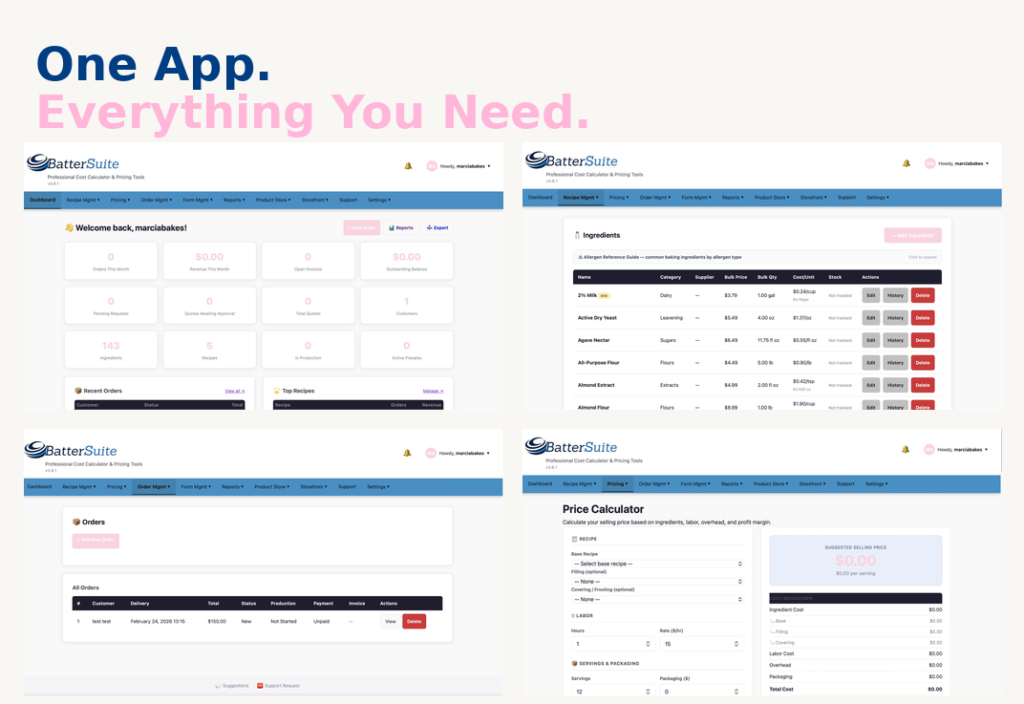
That’s the problem BatterSuite was built to fix. Not just the pricing part โ€” the whole chain from “I have ingredients” to “I got paid and I know if I made money.”

Here’s what it actually does.


You Don’t Know Your Real Recipe Cost Until You Track Every Ingredient

BatterSuite starts at the ingredient level. You build out an ingredient library with costs, units, and nutritional data per 100g โ€” calories, fat, carbs, sugar, protein, sodium, and fiber. You connect ingredients to suppliers so you know where things come from and what you paid. Packaging gets its own tracking too, because yes, that box costs you money.

From there you build recipes. The cost per serving calculates automatically. Nutrition facts per serving pull through automatically. If your ingredient costs change, your recipe costs update. No more guessing.

You can also generate a shopping list straight from selected recipes โ€” the kind of feature that saves you from standing in your kitchen doing math on your phone at 10pm.


Pricing Is Where Most Cottage Bakers Leave Money on the Table

Once your recipe costs are locked in, the pricing tools take over. There’s a general pricing calculator that stacks cost, labor, overhead, and profit margin. There’s a dedicated cake calculator for tiered cakes. There’s a cookie tier tool for pricing by quantity. Both cakes and cookies have add-on pricing for extras.

Overhead is configurable โ€” fixed and variable costs you set yourself. And there are seasonal profiles, so you can save a different overhead setup for your holiday rush versus your slow months. That alone is something most bakers never think to do.

There’s also a presales manager for running pre-order windows with quantity limits and collection slots. If you’ve ever tried to manage a Valentine’s Day presale through DMs, you’ll understand why that exists.

ย 


Orders Are Where Things Get Chaotic Without a System

BatterSuite handles the full order lifecycle. Customers come in through a custom intake form you build yourself. From there you can send a quote, convert it to an invoice, and track it through to completion.

The order management side tracks status, delivery dates, and production info. There’s a production schedule that groups batches by recipe, auto-calculates start dates based on your lead time, and generates ingredient pull sheets so you’re not scrambling the morning of.

There’s also a customer database with contact history and order records โ€” so you actually know who your repeat customers are and what they’ve ordered.


You Have a Public Storefront, Whether You’re Ready or Not

BatterSuite gives you a public-facing storefront you control. You choose which pages are live, customize colors and branding, and display your availability calendar so customers can see when you’re taking orders.

There’s a chat inbox for messages from storefront visitors, and a product catalog for ready-made items available for direct purchase. You can preview exactly what your customers see before anything goes live.


The Money Part Nobody Talks About

There’s a P&L report with visual charts you can filter by date range. There’s a tax summary โ€” federal self-employment tax calculated at 15.3% ร— 92.35% of net profit, quarterly breakdowns, state income tax estimates for all 50 states, and a custom rate override if your situation is different.

You can also export your data for use outside the app.


Email Marketing Built Right In

WhiskMail is BatterSuite’s built-in email marketing module. You can create, schedule, and send campaigns to your customer list and track open rates, clicks, bounces, and delivery per campaign. Audience management handles opt-in status, suppression lists, and consent records. It’s GDPR and CASL-aware by country and auto-injects unsubscribe links and tracking โ€” compliance isn’t something you have to think about separately.


What I Want You to Take Away From This

None of this is fancy software built for restaurant chains or food manufacturers. Every part of BatterSuite was designed around the actual problems home and cottage bakers run into โ€” the underpricing, the disorganized orders, the tax anxiety, the presale chaos.

If you’re still pricing from gut feel or a spreadsheet you built three years ago and haven’t updated, this is worth a look.

โ†’ Try BatterSuite free

[...]

Do You Actually Know What Baking Tools You Own? (Most of Us Don’t)

March 13, 2026
by marciadex
Blog, , , ,

Let me ask you something kind of embarrassing: how many cookie cutters do you own right now? Not a rough guess โ€” the actual number. Do you know every mold in your collection? Every specialty pan you bought for that one order and then shoved in a bin somewhere?

Yeah. Me neither. Or at least, I didn’t for a long time.

If you’ve been baking for more than a year or two, you’ve probably hit that wall where your tools start multiplying faster than you can keep track of them. A cutter set here, a silicone mold there, a specialty cake pan from that one sale you couldn’t resist. Before you know it, you’re digging through bins trying to find the thing you know you have but cannot locate.

And here’s the part nobody talks about: that disorganization costs you real money.

The Problem Is More Common Than You Think

I was browsing CakeCentral forums (a rabbit hole I do not recommend at 10pm) and found a thread about organizing cookie cutters that had bakers describing their collections in the hundreds โ€” one person mentioned having over 3,000 cutters. Three thousand. And the consensus in that thread? Almost everyone had bought duplicates by accident because they simply didn’t know what they already had.

One baker put it perfectly: she kept a list on her computer and wanted to add photos someday because when she’s talking to a customer, she needs to know exactly what shapes she can offer โ€” fast. Another said she kept her inventory on a Palm Pilot (a Palm Pilot!) so she wouldn’t duplicate when she was out shopping.

These are resourceful people doing their best with whatever tools they have. But the underlying problem hasn’t changed in twenty years: there’s no good dedicated solution for tracking what baking equipment you actually own.

What Happens When You Don’t Track Your Tools

Here’s what the chaos actually looks like in practice โ€” and I’ve lived most of these:

You buy duplicates. You’re at a craft store, you see a snowflake cutter, you think “I might have this but I’m not sure,” and you buy it anyway. Three dollars becomes thirty when it happens ten times a season.

You tell customers you can’t do something โ€” when you actually can. A customer asks if you have a specific shape and you say no because you don’t remember that you bought it eighteen months ago. That’s a missed opportunity and a less-than-confident impression.

You waste time hunting instead of baking. Twenty minutes before you’re supposed to start an order is not the time to discover you can’t find the pan you needed. But that’s exactly when it happens.

You can’t accurately price your work. If you don’t know what equipment you have, you can’t account for the wear and replacement cost of those tools in your pricing. Your molds, cutters, and pans are business assets โ€” they have value and they have a lifespan.

You keep buying storage solutions that don’t solve the root problem. Labeled bins are great. Pegboards are great. But physical organization alone doesn’t tell you what you own when you’re away from your workspace โ€” like when you’re at a baking supply shop, on your phone, trying to remember if you already have a 6-inch hexagon pan.

What Bakers Are Actually Doing (And Why It’s Not Enough)

Scroll through any baking forum or Facebook group and you’ll see the workarounds people have cobbled together:

Spreadsheets are the most common answer. Google Sheets, Excel, whatever they have access to. It works โ€” until it doesn’t. Spreadsheets require you to actually update them every time you buy something new (who has time for that?), they’re not built for photos, and they don’t surface information quickly when you’re mid-conversation with a customer.

Photo inventories on CDs or phones. Yes, people have been taking photos of their cutters and saving them to discs to carry around. It’s clever. It’s also a lot of manual effort for something that should be simple.

Memory and vibes. Honestly? Most people. Which is why duplicate buying is basically a rite of passage in this community.

General inventory apps. There are plenty of apps built for retail inventory or crafting supplies. They’ll do the job in a pinch, but they’re not built with bakers in mind. They don’t know what a silicone cavity mold is. They don’t have fields for “condition,” “size,” or “holiday theme.” You end up making the tool work for you instead of the other way around.

What Actually Needs to Exist

What bakers actually need โ€” and what I kept wishing existed every time I dug through my own bins โ€” is something built specifically for this. A way to catalog equipment by category, add photos right from your phone, note condition and quantity, and pull it up instantly when you’re talking to a customer or standing in an aisle trying not to buy something you already own.

That’s the entire reason I started building IcingVault.

IcingVault is a bakery equipment inventory tracker built for home bakers and cottage food operators. Not a general spreadsheet template you have to wrestle into shape. Not a big expensive software suite built for commercial kitchens. Something that actually makes sense for the way we work โ€” where “inventory” means cookie cutters organized by season, silicone molds by cavity count, and cake pans by size and finish.

I’m still building it. I’ll be honest with you about that, because that’s how I operate here. But it’s being built by someone who has lived this exact frustration, not by a developer who googled “what do bakers need.”

In the Meantime: A Starting Point

If you want to start getting a handle on your equipment right now, here’s the simplest version that actually works:

Pick one category โ€” just one. Cookie cutters, cake pans, silicone molds, whatever is causing you the most grief. Go through that category, take photos on your phone, and drop them into a Google Photos album labeled by theme or type. Add a quick note to each photo with size, material, and where you store it. That’s it. Imperfect and incomplete is still a thousand times better than nothing, and you can build from there.

The goal isn’t a perfect system on day one. It’s knowing what you have well enough to stop buying duplicates and start answering customer questions with confidence.

You Deserve Tools That Actually Work for You

One thing I’ve learned from running a real bakery is that the business side โ€” the tracking, the pricing, the organizing โ€” can quietly drain just as much energy as the baking itself. And when the tools don’t exist or aren’t built for people like us, we end up spending that energy on workarounds instead of on our actual craft.

That’s what SweetTube Academy is here to change. Not by telling you what the experts say. By figuring it out alongside you and building the tools we both need.

If IcingVault sounds like something you’ve been waiting for, head over ย sweettubeacademy.com/icingvault. And if you have a tool-tracking system that’s working for you right now โ€” a spreadsheet, a method, anything โ€” drop it in the comments. I genuinely want to know what you’re doing. It helps me build better.

We’re in this together.

โ€” Marcia


ย 

[...]

Are You Pricing Out of Thin Air? Here’s What That’s Costing You

March 12, 2026
by marciadex
Blog

Let me ask you something uncomfortable.

When your last customer asked how much for a dozen custom cookies, where did that number come from? Did you calculate it โ€” like, actually sit down and add up ingredients, time, overhead, and profit? Or did you kind of just… feel it out?

No judgment. I did the same thing for longer than I care to admit.

The problem is that “feeling it out” is quietly wrecking your business, and most bakers don’t realize it until they’re burned out, broke, or both.

Pricing Out of Thin Air

You need $45 for a dozen cookies. Why $45? Because it sounds reasonable. Because you’ve seen other bakers charge that. Because the customer seemed like they’d say yes at $45 but no at $55.

That’s not pricing. That’s guessing. And guessing means some orders make you money and some orders cost you money โ€” and you have no idea which is which.

Real pricing starts with your actual costs: every cup of flour, every stick of butter, every food coloring drop, the piping bags, the boxes, the electricity running your oven. Add your time. Add a margin for profit. That is your price.

Copying a Competitor’s Price Without Knowing Their Math

This one is so common. You find a baker in your area charging $60 a dozen and you think, okay, I’ll charge $58 and undercut them a little.

But here’s what you don’t know: maybe they buy ingredients wholesale and their cost per dozen is $12. Maybe they work out of a licensed commercial kitchen they share with three other bakers. Maybe their $60 is wildly profitable. Maybe it’s not and they’re also struggling.

You’re matching a number with zero context. Your costs are yours. Your time is yours. Your price has to be built on your numbers, not theirs.

Forgetting to Pay Yourself

This one stings. A lot of us count ingredient costs, maybe packaging, and call it a day. Then we wonder why we’re exhausted and have nothing to show for it.

Your time is a cost. If you spend four hours on a cake order and you don’t factor in an hourly rate for yourself, you just worked for free. Actually, you paid to work โ€” because your time has value, and you spent it without compensation.

You wouldn’t hire an employee and forget to pay them. Stop doing that to yourself.

Overpricing โ€” and Not Knowing It

The flip side is real too. If your orders have slowed down and you’re not sure why, pricing might be the culprit โ€” but not the way you think.

Sometimes bakers overprice because they overestimate how long things take, or they’re double-counting costs, or they never revisited prices after ingredient costs dropped. Overpricing isn’t just a lost sale. It erodes trust when customers compare you to others and can’t figure out why there’s such a gap.

Knowing your actual numbers tells you when you have room to be competitive and when you genuinely can’t go lower without losing money.

So… Are You a Spreadsheet Person?

For years, the answer for bakers was: build a spreadsheet. Add formulas. Update it every time ingredient prices change. Keep another tab for recipes. Cross-reference everything manually.

Some bakers are spreadsheet people. If that’s you and it’s working โ€” genuinely, keep going.

But a lot of us are not spreadsheet people. And even the ones who are will admit that maintaining a pricing spreadsheet while also running a bakery is a lot. It’s one more thing to update, one more thing to lose track of, one more thing to feel behind on.

We Started With a Spreadsheet. Here’s Where We Ended Up.

That’s exactly where BatterSuite started โ€” as my own spreadsheet. I was running Marcia’s Micro-Bakery, trying to track ingredient costs and figure out why some orders felt profitable and others felt like I was spinning my wheels.

I turned that spreadsheet into a WordPress plugin so other bakers could use it. And then I kept going.

BatterSuite is now a full SaaS app โ€” and I mean full. A storefront, an ingredient library, a recipe builder, a price calculator that actually does the math for you, stock tracking, order management โ€” all in one place. No more bouncing between tabs. No more outdated formulas. No more guessing.

And we’re not done. By the end of the year, the goal is to bring email marketing into the platform too โ€” so you’d have everything you need to run and grow your baking business without ever leaving the app. I’m building it the way I wish it had existed when I was starting out.

What Knowing Your Numbers Actually Changes

When you price from data instead of gut feelings, a few things happen: you stop taking orders that lose you money, you quote prices confidently without second-guessing yourself, you know your floor so you know when to flex and when to hold the line โ€” and you actually see profit at the end of the month.

That’s not a small thing. That’s the difference between a hobby that costs you money and a business that pays you.

Ready to Stop Guessing?

BatterSuite is live. If you’re tired of pricing by feel, copying numbers you don’t understand, or working hard without seeing it pay off โ€” this was built for exactly that.

Check out BatterSuite and get started โ†’

We’re building this together. And your prices should finally work for you.

[...]

How to Calculate Your Overhead as a Home Baker: The Complete Mathematical Guide

March 02, 2026
by marciadex
Blog, , , ,

How to Calculate Your Overhead as a Home Baker

The Complete Mathematical Guide

Stop guessing at your costs and start pricing profitably with this step-by-step overhead calculation system


If you’ve ever looked at your monthly expenses and wondered “How much of this should I add to each cake?” โ€“ you’re not alone. Most home bakers struggle with overhead calculation, leading to underpriced products and burnt-out bank accounts.

The truth? Overhead calculation isn’t hard โ€“ it just requires the right formula.

In this guide, you’ll learn the exact mathematical method professional bakeries use to calculate overhead costs, adapted specifically for home-based operations. No guesswork, no complicated accounting software โ€“ just straightforward math that ensures every product you sell contributes to covering your business expenses.

What Exactly IS Overhead?

Overhead costs are all the expenses required to run your baking business that aren’t directly tied to a single product.

Think of it this way:

Direct costs: Flour, sugar, eggs for a specific cake

Overhead costs: Your oven’s electricity, business insurance, packaging supplies, website hosting, kitchen equipment depreciation

Overhead is real money leaving your pocket every month, and if you’re not factoring it into your prices, you’re subsidizing your business with your personal funds.


The Home Baker’s Overhead Calculation Formula

Step 1: List ALL Your Monthly Business Expenses

Create a comprehensive list of every expense your baking business generates each month. Be thorough โ€“ small expenses add up quickly.

Fixed Overhead (Same Every Month)

  • Business insurance
  • Website hosting
  • Business phone/internet portion
  • Software subscriptions
  • Business loan payments
  • Kitchen equipment lease/rental
  • Professional fees

Variable Overhead (Changes Each Month)

  • Electricity (baking portion)
  • Gas (baking portion)
  • Water (baking portion)
  • Packaging supplies
  • Labels and stickers
  • Business mileage/delivery
  • Marketing/advertising
  • Equipment maintenance
  • Cleaning supplies

Depreciation Formula

Annual Depreciation = (Purchase Price – Resale Value) รท Lifespan Years
Monthly Depreciation = Annual Depreciation รท 12

๐Ÿ’ก Example:

Stand mixer: $500
Resale value: $100
Lifespan: 5 years
Annual: ($500-$100)รท5 = $80
Monthly: $80รท12 = $6.67/month

Step 2: Calculate Total Monthly Overhead

Business Insurance:           $75
Website & Email:              $30
Utilities:                    $85
Packaging:                    $120
Labels:                       $40
Depreciation:                 $25
Marketing:                    $50
Home Office:                  $180
Cleaning:                     $30
-----------------------------------
TOTAL MONTHLY OVERHEAD:       $635


Step 3: Calculate Overhead Per Product

Three methods depending on your business:

Method A: Per-Unit

Best for high-volume bakers

Overhead Per Unit = Total Monthly Overhead รท Units Sold

Example: $635 รท 80 items = $7.94 per item


Method B: Per-Hour

Best for custom products

Hourly Overhead = Monthly Overhead รท Hours Worked
Product Overhead = Hourly Rate ร— Hours for Product

$635 รท 60 hours = $10.58/hour
Simple cake (2 hrs): $21.16
Custom cake (8 hrs): $84.64


Method C: Percentage

Best for recipe-based

Overhead % = (Monthly Overhead รท Monthly Ingredients) ร— 100
Product Overhead = Ingredients ร— Overhead %

($635 รท $1,200) ร— 100 = 53%
Cake ($15 ingredients): $7.95 overhead
Cookies ($8 ingredients): $4.24 overhead

Special Case: Cookie Overhead & Pricing

Cookies require different overhead thinking than cakes because labor time varies dramatically based on decoration level. Let’s break down why custom cookies should cost $6+ each (and how to justify it).

โš ๏ธ The Cookie Time Reality Check

Most bakers think cookies take 1 hour. They actually take 3+ hours for custom work.

Real Cookie Labor Breakdown (2 Dozen)

Mixing dough:                 20 minutes
Rolling & cutting:            30 minutes
Baking (2-3 batches):         40 minutes
Cooling time:                 15 minutes
Making royal icing:           20 minutes
Decorating 24 cookies:        60-90 minutes
Cleanup:                      15 minutes
โ”โ”โ”โ”โ”โ”โ”โ”โ”โ”โ”โ”โ”โ”โ”โ”โ”โ”โ”โ”โ”โ”โ”โ”โ”โ”โ”โ”โ”โ”โ”โ”โ”โ”โ”โ”โ”โ”
TOTAL LABOR TIME:             3-3.5 hours

This is for custom decorated cookies. Plain or simply decorated cookies take less time, but most customer orders fall into the custom category.

Cookie Pricing by Decoration Level

Tier 1: Plain/Minimal Cookies

Cut-out shapes, minimal decoration, basic sprinkles

Labor Time: 1 hour for 2 dozen

Ingredients:                  $7.00
Labor (1 hr @ $25):          $25.00
Overhead (1 hr @ $10.58):    $10.58
โ”โ”โ”โ”โ”โ”โ”โ”โ”โ”โ”โ”โ”โ”โ”โ”โ”โ”โ”โ”โ”โ”โ”โ”โ”โ”โ”โ”โ”โ”โ”โ”โ”
Subtotal:                    $42.58
Profit (30%):                $12.77
โ”โ”โ”โ”โ”โ”โ”โ”โ”โ”โ”โ”โ”โ”โ”โ”โ”โ”โ”โ”โ”โ”โ”โ”โ”โ”โ”โ”โ”โ”โ”โ”โ”
TOTAL: $55 for 2 dozen

Per Dozen: $27.50
Per Cookie: $2.29

Tier 2: Simply Decorated Cookies

Basic royal icing, simple designs, 2-3 colors

Labor Time: 1.5-2 hours for 2 dozen

Ingredients:                  $7.00
Labor (1.5 hrs @ $25):       $37.50
Overhead (1.5 hrs @ $10.58): $15.87
โ”โ”โ”โ”โ”โ”โ”โ”โ”โ”โ”โ”โ”โ”โ”โ”โ”โ”โ”โ”โ”โ”โ”โ”โ”โ”โ”โ”โ”โ”โ”โ”โ”
Subtotal:                    $60.37
Profit (30%):                $18.11
โ”โ”โ”โ”โ”โ”โ”โ”โ”โ”โ”โ”โ”โ”โ”โ”โ”โ”โ”โ”โ”โ”โ”โ”โ”โ”โ”โ”โ”โ”โ”โ”โ”
TOTAL: $78 for 2 dozen

Per Dozen: $39
Per Cookie: $3.25

Tier 3: Custom Decorated Cookies โญ

Detailed royal icing, multiple colors, intricate designs, flooding & piping

Labor Time: 3-3.5 hours for 2 dozen

Ingredients:                  $7.00
Labor (3 hrs @ $25):         $75.00
Overhead (3 hrs @ $10.58):   $31.74
โ”โ”โ”โ”โ”โ”โ”โ”โ”โ”โ”โ”โ”โ”โ”โ”โ”โ”โ”โ”โ”โ”โ”โ”โ”โ”โ”โ”โ”โ”โ”โ”โ”
Subtotal:                   $113.74
Profit (30%):                $34.12
โ”โ”โ”โ”โ”โ”โ”โ”โ”โ”โ”โ”โ”โ”โ”โ”โ”โ”โ”โ”โ”โ”โ”โ”โ”โ”โ”โ”โ”โ”โ”โ”โ”
TOTAL: $148 for 2 dozen

Per Dozen: $74
Per Cookie: $6.17

โœ… Market Reality: Custom decorated cookies from professional bakers typically sell for $4-10 per cookie. At $6.17, you’re competitively priced in the middle range.

Why Most Bakers Underprice Cookies

โŒ The Wrong Math (What Most Bakers Do)

Ingredients: $7.00 ร— 3 = $21 for 2 dozen
Per dozen: $10.50
Per cookie: $0.88

This covers ONLY ingredients. No labor. No overhead. No profit.

โœ… The Right Math (Professional Pricing)

Ingredients + Labor + Overhead + Profit = $148 for 2 dozen
Per dozen: $74
Per cookie: $6.17

This covers everything AND pays you properly for skilled work.

How to Justify $6+ Per Cookie Pricing

๐Ÿ’ฌ

1. Educate Your Customers

“Each cookie takes 7-10 minutes to hand-decorate with royal icing. That’s the same time an artist spends on a small painting. You’re not buying a cookieโ€”you’re buying edible art.”

๐Ÿ“ธ

2. Show Your Process

Post behind-the-scenes videos showing the 3+ hours of work. Time-lapse videos of decorating make customers understand the effort involved.

๐ŸŽฏ

3. Target the Right Market

Focus on custom events (weddings, corporate, milestone birthdays) where customers value quality over price. Avoid competing with grocery store cookies.

๐Ÿ†

4. Position as Premium

Use terms like “custom decorated,” “hand-piped,” “edible art,” “artisan cookies.” Professional branding, beautiful photos, and consistent quality justify premium prices.

๐Ÿ“Š

5. Offer Tiered Pricing

Give customers options: Simple decorated ($3.25), Standard custom ($4.50), Premium intricate ($6.17+). This shows value progression and lets budget-conscious customers self-select.

๐Ÿ’ก Pro Tip: Minimum Order Requirements

Set a minimum of 1-2 dozen for custom cookies. Small orders (6 cookies) still take 2+ hours of work, which makes them unprofitable. Your time setting up, baking, and decorating is the same whether you make 6 or 24 cookies.

โœ… The Bottom Line on Cookie Pricing

If you’re spending 3 hours decorating 2 dozen cookies and charging $40 ($1.67/cookie), you’re earning:

$40 – $7 ingredients = $33 รท 3 hours = $11/hour before overhead

You’re literally earning less than minimum wage. Charge what your skills, time, and business costs actually require: $6+ per custom cookie.


Step 4: Final Product Price

Price = Ingredients + Labor + Overhead + Profit

๐ŸŽ‚ Complete Example:

Ingredients: $22.00
Labor (3hrs ร— $25): $75.00
Overhead (3hrs ร— $10.58): $31.74
Subtotal: $128.74
Profit (30%): $38.62
FINAL: $170

How BatterSuite Calculates Overhead for You

Manually tracking expenses is time-consuming. BatterSuite automates it all.

โœ… Tracks all business expenses automatically
โœ… Calculates equipment depreciation
โœ… Updates overhead rates as expenses change
โœ… Applies correct overhead to each product
โœ… Shows exact costs including overhead

Quick Overhead for Cakes & Cookies

The SweetPrice Calculator WordPress plugin gives instant overhead-inclusive pricing for cakes and cookies.

โœ… No more underpricing custom orders
โœ… No manual calculations for quotes
โœ… No guessing if you’re profitable
โœ… Customers get instant accurate quotes


FAQ

Should I include my salary in overhead?

No. Labor is separate. Overhead is business expenses only.

What if overhead seems high?

Common for small-volume bakers. Increase sales to spread costs across more units.

How often recalculate?

Every 3-6 months or when major changes occur.

The Bottom Line

Calculating overhead isn’t optional โ€“ it’s the difference between profit and hobby.

Stop guessing. Start calculating. Price profitably.

Questions? Email support@sweettubeacademy.com

Marcia Rivera is the founder of SweetTube Academy and owner of Marcia’s Micro-Bakery in Beachwood, NJ. She’s been teaching home bakers profitable business practices since 2025.

[...]